
New Tech for Old History
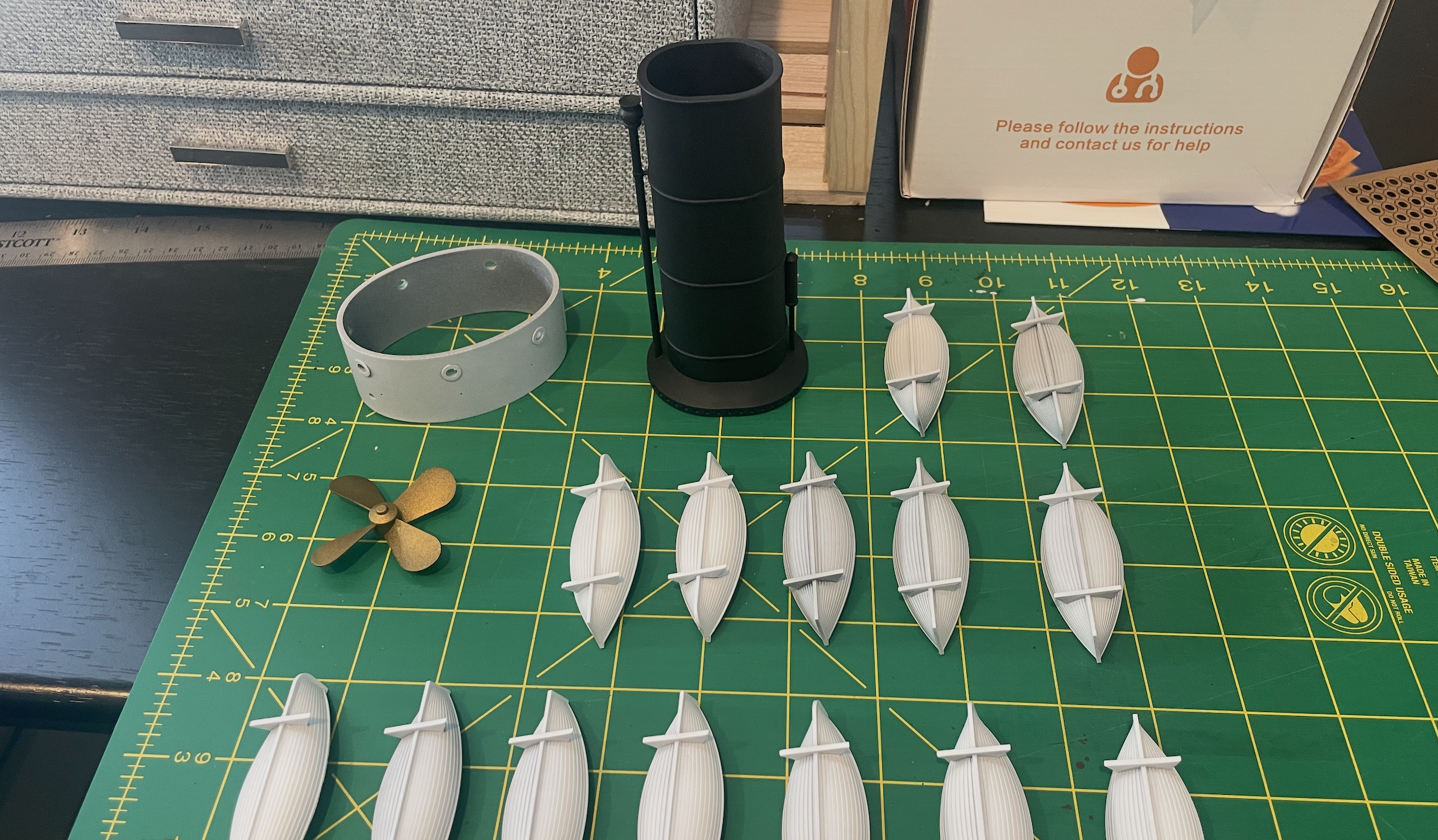
Finished 3D Printed Parts for the SS Christopher Columbus
As the project crosses the half-way point, an important milestone was completed just this past week. All of the nearly 70 3D-printed parts for the Columbus have been designed and produced. With this major task finished, now is a great time to share the decisions and work that went into using 3D printing technology for a project like this.
When taking on a museum miniature, there is a crucial decision that needs to be made for of how best to make the highly-detailed parts (e.g. the ship’s bollards, anchors, propellor). One of the major considerations was choosing an archival material that would be stable over many decades. Metal castings would certainly provide longevity but would add complexity and production time. To keep costs and production times down, 3D printing was the best option, but there were many factors to consider. There are many types of 3D printing technologies (e.g. FDM, SLS, SLA, etc.), each with pros and cons. Overall cost, level-of-detail, production time, and material specs are all considerations that go into the selection.
The decision was debated for over two months. Several early prototypes were created with different printing technologies and materials to inform the final decision. Fortunately, once the model is completed, it will sit behind glass and be rarely touched by people. However, the pieces still need to be as strong and stabile as possible. This is where “tough” resin comes in. Tough resins on high-resolution, SLA printers are formulated to take high loads before they fail and to be less brittle than typical UV-cured resins. When properly cured with heated systems, the finished pieces become a very strong option. The resin does cost more, but the end product is intended to last a long time.
One of the best things about having a 3D printer in the shop is the ability to reprint parts that don’t turn out right the first time. There were many examples on this project of parts that required multiple iterative prints to get right. Within a couple hours, a first iteration part can be printed, tested, thrown away, redesigned in CAD, and reprinted once again. It is a fantastic technology for the scale modeler doing commissioned work.